


EXECUTIVE SUMMARY
- The index has never been more concentrated; its members have rarely agreed less. Concentration is a weight. Correlation is a behaviour. April confounded the two.
- Alphabet rose 34 per cent — its best month since 2004 — in the same month its supposed confederates fell on the same sessions. The Magnificent Seven has become a bracket, not a bloc.
- Implied correlation has slid toward its lowest levels in decades even as the top of the index sets records for size. The placid volatility index is a composition artefact, not a verdict of calm.
- The wrong response is “sell tech.” The right one is to stop treating tech as one decision.
- Our regime read remains Reflation: dispersion of this order rewards selection over exposure, and argues for deliberate breadth over inherited concentration.
The band, reunited?
On the last day of March, every member of the Magnificent Seven was down for the year. Not slightly: Microsoft had lost nearly a quarter of its value, Tesla 17 per cent, Meta 13. Then April happened — a nine-per-cent month for the index, a fifteen-per-cent month for the Nasdaq, four-point-eight trillion dollars restored to the Seven — and the commentary reached, as it always does, for the collective noun. The band was back together.
Look closer and the band recorded seven solo albums. Alphabet returned 34 per cent, its finest month in twenty-two years, on the strength of its cloud business, its advertising and its self-driving cars. Yesterday, as four of its peers reported, it rose ten per cent in a session — while Meta fell eight, Microsoft four and Nvidia three, every other sector in the index advanced, and the Russell 2000 led the market. One name’s best day in a year; three names sold on their own numbers; the small caps out in front. That is not a bloc having a good month. That is a bracket, drawn around companies that have stopped moving as one.
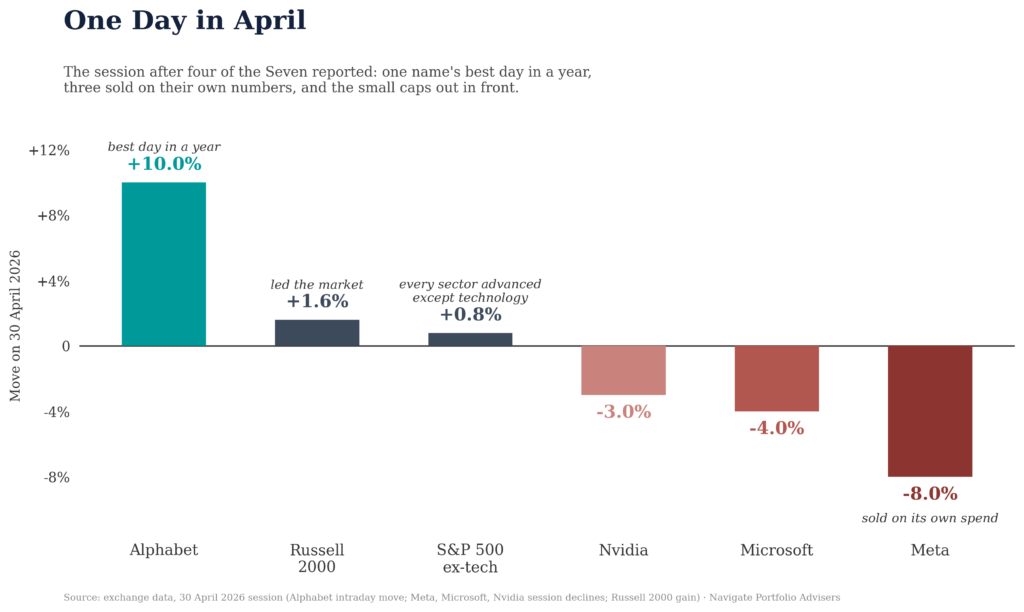
Figure 1: One Day in April
Weight is not agreement
Here is the distinction the consensus keeps eliding. Concentration measures how much of the index a handful of names weigh. Correlation measures whether they act in concert. The first is at records — the equal-weighted index rose barely six per cent in a month the headline index rose ten, which tells you the top did the lifting. The second has collapsed: the market’s implied-correlation gauges have been sliding toward their lowest readings in at least two decades. We are asked to believe the index has never been riskier because it has never been narrower. The options market is pricing something closer to the opposite — a narrow index whose members disagree profoundly.
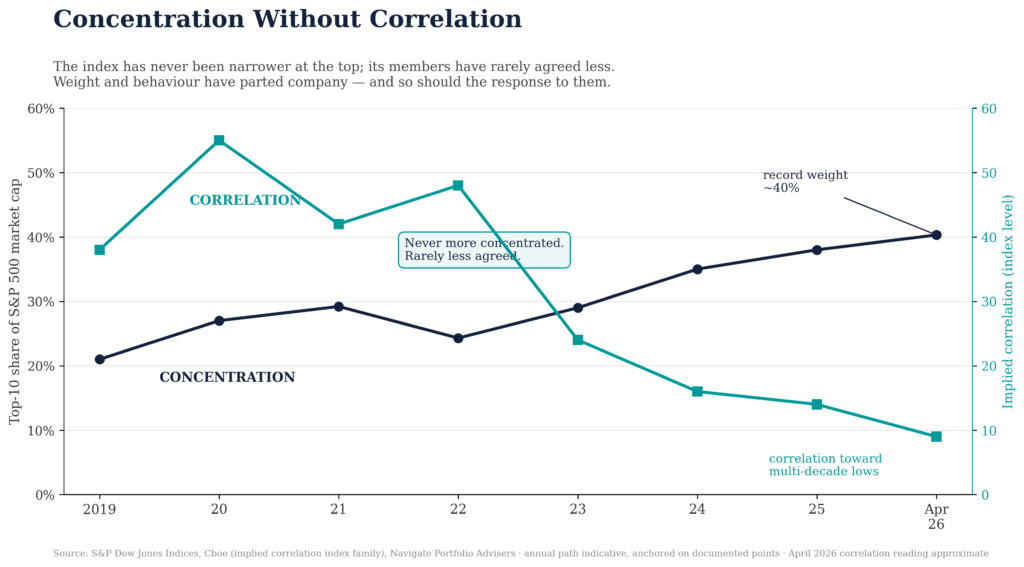
Figure 2: Concentration Without Correlation
Both can be true, and presently are. Which matters, because the standard prescription — trim the Seven, diversify the concentration away — treats seven positions as one. They no longer are. They were only ever seven businesses temporarily possessed by a single factor: first the discounting of distant profits at zero rates, then the letters A and I. Remove the common possession and they revert to type — an advertising business, a chip cycle, an enterprise annuity, a device franchise, a capital-expenditure question mark. Alphabet and Meta disagreed by eighteen percentage points in one session this week. Owning “the Seven” is not a position. It is seven.
Where the volatility went
The second-derivative point, and the one we suspect the market will spend the summer learning: index volatility is, mechanically, the product of how much its constituents move and how much they move together. Let correlation fall far enough and the index can grow calmer while its members grow wilder — which is a fair description of April, a month in which a shooting war, hundred-dollar oil and a divided Federal Reserve produced record index highs and a tranquil VIX. The calm is not the absence of risk. It is risk relocated from the index to the spaces between its members, where it is harder to see and easier to own by accident. A cheap insurance premium on the whole is presently the market’s way of telling you the danger has moved inside.
Concluding thoughts
Through our QuadLogic lens the regime remains Reflation, and this is what Reflation looks like at the single-stock level: nominal growth flowing unevenly, capital expenditure rewarding some balance sheets and indicting others, and the tide no longer lifting boats indiscriminately. Such conditions reward selection over exposure. The investor who “owns the market” today owns a record weight in a handful of companies that have stopped agreeing with one another — concentration without the diversifying courtesy of correlation.
We would rather choose. Breadth held deliberately, dispersion treated as opportunity rather than noise, and the Seven approached as seven decisions — some of which we like considerably more than others. The differences, as the lawyers say, are irreconcilable. Portfolios should stop pretending otherwise.
This document is a market commentary intended for professional advisers and institutional investors. It does not constitute investment advice, an offer to buy or sell any security, or a recommendation. Views expressed are those of the author at the time of writing and are subject to change without notice. Past performance is not a reliable indicator of future returns; the value of investments may fall as well as rise. Investors should consult their financial adviser before acting on any view contained herein.