

The Long Lead
The market has priced the chips. It has not priced the copper box that energises them.
A PROBLEM OF SEASONED OAK
The Royal Navy’s difficulty, through the whole of the eighteenth century, was never ships. It was oak. A first-rate ship of the line consumed something in the region of two thousand mature trees, and the timber had to be seasoned for three years before a shipwright would touch it. You could vote a fleet through Parliament in an afternoon. You could not hurry the drying sheds at Chatham. The consequence, faintly absurd to anyone who has only read the battle histories, is that British naval capacity in 1800 was set by decisions taken about woodland in the 1770s, and by the patience of men who were dead before the ships were launched.
The point survives the change of subject. In any industry where a physical input has a long and inelastic preparation time, ambition is set not by capital but by whatever was ordered several years earlier. Capital can be raised in a morning — Alphabet has demonstrated as much, and we shall come to it. Seasoning cannot.
Artificial intelligence has now acquired its seasoned oak. It is a steel tank of wound copper and mineral oil, it weighs several hundred tonnes, it is ordered two and a half years before it is needed, and almost nobody writing about the AI trade has mentioned it.
THE CONSENSUS CALL
The bull case deserves a proper hearing, because it is largely correct. Alphabet has raised 2026 capital expenditure guidance twice this year, landing between $195bn and $205bn, against $91.4bn in 2025 and $52.5bn the year before. Its chief financial officer has told the market that 2027 will rise significantly again. Second-quarter spending alone ran at $44.9bn, roughly double the prior year, and free cash flow turned negative in the process — a company of that vintage does not consume cash by accident.
Nor is the demand behind it imagined. Google Cloud revenue grew 82 per cent year on year in the second quarter; the contracted order backlog stands at $514bn, having risen by more than $50bn in a single quarter. Across the four large hyperscalers, 2026 capital expenditure is tracking toward some $725bn. And the funding is now unmistakably that of an infrastructure sponsor rather than a software company: Alphabet’s long-term debt reached $98.2bn by the end of June, having quadrupled through 2025, with more than $50bn issued in the first half of this year across five currencies. There was a hundred-year sterling bond in there, the first century issuance by a technology company since Motorola in 1997, and an equity raise of $84.75bn carrying two series of mandatory convertible preferred.
So the consensus has it half right, which is its usual condition. Demand is real, funding is secured, and the buildout will happen. What the consensus has not done is ask when.
DRAWING THE LINE
It stops one layer above the equipment.
The numbers are not obscure; they are simply unfashionable. Wood Mackenzie’s survey put large power transformer lead times at around 128 weeks, with substation-class units quoted at three to five years. Generator step-up units averaged 144 weeks, with specialised orders stretching toward four years. Medium-voltage switchgear at 15kV now runs 52 to 80 weeks against roughly 24 before the pandemic; 38kV equipment reaches 78 to 104. Large gensets in the two to three megawatt class run six to twelve months and, in backlog conditions, eighteen — Cummins has reported being sold out of high-horsepower units through 2028. Transformer prices are up on the order of 77 per cent since 2019, which is the tell: when a shortage is real, price and delay rise together rather than trading against one another.
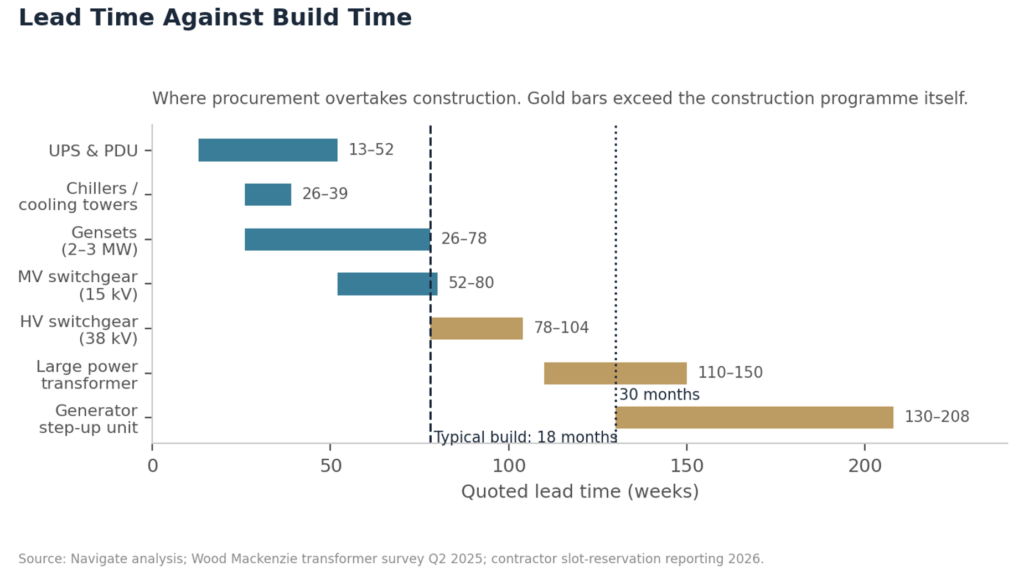
Chart 1. Lead time against build time. Quoted delivery windows for the principal electrical and mechanical plant, set against an eighteen to thirty month construction programme.
Read that chart the way a contractor reads it. A data centre shell takes sixteen to twenty-four weeks. The whole construction programme runs eighteen to thirty months. Three categories of equipment now take longer than the building they go into, which means the critical path has left the site altogether and relocated to a factory order book. The equipment closest to the grid interface has the longest and most volatile lead times, and it is precisely that equipment which decides when firm power can reach the facility. A building can be structurally complete, commissioned, staffed and entirely unable to operate.
THE ENERGISATION GAP
This is the series we propose to run, and it is not published anywhere.
The Energisation Gap is announced capacity less capacity with both executed interconnection and confirmed equipment delivery slots, by market, updated monthly from utility filings, manufacturer slot announcements and connection-queue disclosures. It is constructible. It is also, we suspect, the reason a good deal of forecast capacity will not appear.
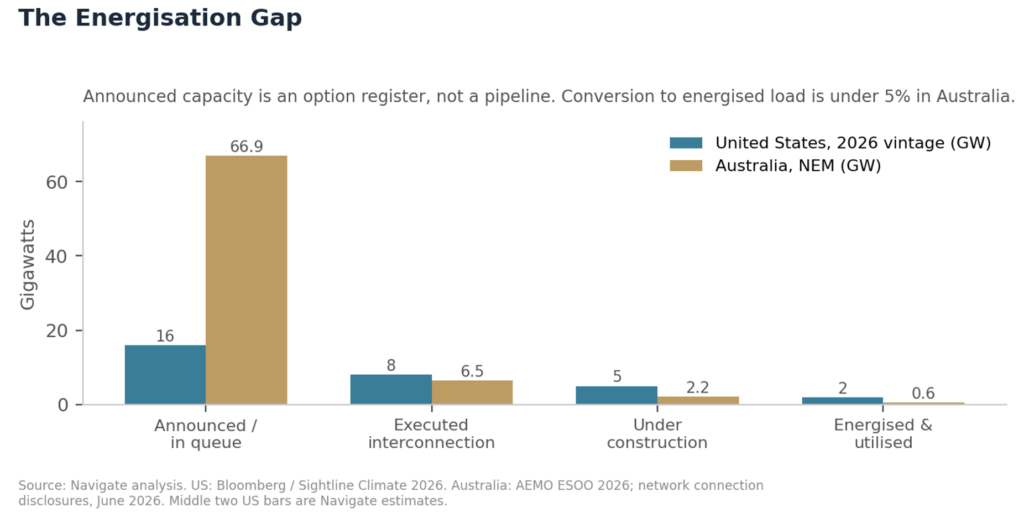
Chart 2. The Energisation Gap. From announcement to drawn load, in two markets.
The Australian figures are the more brutal, because the disclosure is better. As at June 2026, prospective data centre projects had generated 66.9 gigawatts of grid connection requests across 225 projects, up from 38 gigawatts a year earlier. In the same period, 36 per cent of the previous year’s list had been cancelled. Operating facilities across the National Electricity Market held about 2.2 gigawatts of maximum connection capacity, and actual demand ran at roughly 27 per cent of that. Somewhere under one per cent of requested capacity is currently drawing load.
The American evidence is thinner but points the same way: of roughly twelve gigawatts of capacity slated to come online in 2026, about a third was under active construction, with transformers, switchgear and batteries cited as the cause. Industry estimates put 30 to 50 per cent of planned 2026 openings at risk of delay or cancellation.
PRICING OPTIONALITY
The connection queue is not a pipeline. It is an option register, and options are free to write.
We say this plainly because the queue is being quoted as demand in a great many places where it should be quoted as intent. A connection request costs a developer very little and secures a place in a line that may prove valuable. It commits nobody to anything. The Australian market has given the term of art — phantom demand — and the market operator has been candid that applications are being made for connections that will never materialise.
The honest version of the number is a conversion rate, and ours is the first we have seen published. We will carry it forward and be judged on it.
THE SECOND DERIVATIVE TRADE
The discipline requires running the rate of change on supply as well as demand, and both are informative.
On demand, the level is still rising and the rate is beginning to moderate. Guidance raised twice in a year is a level effect; the interesting question is whether the third raise comes, and whether 2027’s “significant increase” is accompanied by a further fall in free cash flow. A sponsor running negative cash flow to build is a sponsor whose board will eventually ask about the return.
On supply, relief is coming and it is dated. Siemens will invest at least $185m in a 550,000 square foot plant in Jackson County, Georgia, building low-voltage components for power distribution — precisely the constrained category. Construction begins in November 2026, with roughly three years to full buildout and hiring from 2027. That is relief arriving in 2029. It is not relief arriving in 2027, which is when a great deal of announced capacity is supposed to energise.
The awkward arithmetic, therefore, is that the shortage resolves at almost exactly the moment demand growth may be moderating. That is the classic shape of a capital-goods cycle, and it is why we are long the complex with a defined horizon rather than indefinitely.
“We stopped treating switchgear as a purchase order some time in 2024. It is now the first line of the programme and everything else is scheduled behind it.”
— Senior procurement lead, European EPC contractor.
THE POSITION
Three expressions, in order of conviction.
Long the electrical capital-goods complex — transformers, switchgear, and the balance-of-plant that sits between the grid and the hall — with a horizon that ends when the 2029 capacity additions commission rather than an indefinite hold.
Long assets with energised capacity. A site with an executed interconnection agreement, an energised substation and documented headroom is not the same asset as a site with a queue position, and the market has only recently begun to price the difference. We expect that spread to widen before it narrows.
Short, in the analytical rather than the literal sense, the assumption that announced megawatts convert. Any thesis that runs off the connection queue should be re-underwritten off the Energisation Gap.
The principal risk to all three is a demand air-pocket. If capital expenditure growth stalls in 2027 whilst the 2029 capacity comes on regardless, the equipment makers face a cliff of their own making, and the speed-to-power premium on energised land compresses sharply. We would rather name that risk than discover it.
CONCLUDING THOUGHTS
There is a particular kind of error that recurs whenever an industry becomes exciting, which is to count the thing that is visible and ignore the thing that is slow. The Admiralty counted ships. The market counts chips. In both cases the answer was in a yard somewhere, drying, and had been settled years before anybody thought to ask.
We are not sceptical about the buildout. We are sceptical about the date. Fleets are sized by timber yards, and the market is still counting ships.
“The queue tells you who has ambition. The interconnection agreement tells you who has a project. There is an order of magnitude between them.”
— Navigate Portfolio Advisers
SOURCES AND NOTES
Alphabet Q2 2026 results and guidance; Alphabet debt and equity issuance disclosures to 30 June 2026. Wood Mackenzie transformer survey, Q2 2025. Contractor slot-reservation reporting and manufacturer lead-time disclosures, 2026. AEMO 2026 Electricity Statement of Opportunities; Australian network business connection disclosures, Q1–Q2 2026. Bloomberg and Sightline Climate reporting on US 2026 capacity. Siemens Jackson County announcement, August 2026. Charts 1 and 2 are Navigate constructions; the two middle bars of the US series in Chart 2 are Navigate estimates and are flagged as such on the chart. Prior in this argument: “Trading Places: the Net Zero Fiscal Trilemma”; “How To Invest For An Electrified Society”.