

On the evening of 28 May, residents along Florida’s space coast felt their homes shake before they understood why. A New Glenn rocket, fuelled and tethered to Launch Complex 36 for a routine static-fire test, had detonated. The blast occurred during a standard procedure in which engines are ignited while the rocket remains secured to the pad. Bezos, characteristically, told the world via X that itwas “too early to know the root cause,” before adding: “Very rough day, but we’ll rebuild whatever needs rebuilding and get back to flying. It’s worth it.” The orange light along the beach was, depending on one’s vantage, a reminder of physics or a reminder of competition. The same week, the financial press concerned itself with the other rocket company — the one whose S‑1 had just landed onSEC EDGAR.
SpaceX is going public on 12 June under the ticker SPCX, at a target valuation of $1.75 to
$2 trillion, raising roughly $75 billion through twenty-one underwriters. It will be, by a comfortable margin, the largest listing in history. Up to 30% of the float has been earmarked for retail — about triple the standard allocation for an offering of this size. The Bulletin’s view is that the industry deserves the capital flowing into it. The IPO, at the offered price, almost certainly does not. The trade worthowning here is mostly not the one going public.
The prospectus reads like cosmology
Begin with what is genuinely extraordinary. Starlink, the connectivity arm, generated
$11.4 billion of revenue in 2025 at a 36% operating margin — one of the better subscription businesses ever built, complete with a real moat, ten million paying customers, and no credible competitor. If that were the entirety of the company, it would deserve most of the breathless coverage.
It is not the entirety of the company. The S‑1 discloses a four-business conglomerate: Starlink, the loss-making launch business that exists to feed Starlink, an AI division (xAI/Grok) that lost $6.4 billion from operations in 2025 and burned $7.7 billion of capex in asingle quarter, and X — the social media platform absorbed by xAI in 2025 before xAI was absorbed by SpaceX in early 2026. The headline 2025 revenue of $18.7 billion folds all three together; standalone SpaceX did closer to $15–16 billion. The prospectus also carries around $530 million in active legal liabilities tied chiefly to Grok, and 18,712 bitcoin marked to market every quarter from listing onward.
Then there is the total addressable market. SpaceX claims $28.5 trillion — a figure within a rounding error of US GDP, and described by the company, without irony, as “the largest actionable TAM in human history.” Of that figure, 93% is artificial intelligence, with $22.7 trillion attributed to enterprise applications. The businesses currently producing operating profit account for less than 7% of the opportunity being sold. Markets do not actionably address the entire economy, and prospectuses that claim otherwise are doing something other than accounting.
The interesting paragraph is on page many
Buried in the filing is the most consequential disclosure in the document. Anthropic — direct competitor to xAI’s Grok — has agreed to pay SpaceX $1.25 billion per month for compute capacity through May 2029. That is roughly $15 billion in annualised revenue from a single customer, monetising infrastructure already built. The implication, read clearly, is that SpaceX is quietly stepping out of the foundation-model race and repositioning as the infrastructure layer beneath it. Owning the layer below — power, GPUs, data centres,eventually orbital compute — and selling capacity to the labs trying to win the layer above.
This is a more durable franchise than another frontier model. It is also a more capital-intensive one, which is partly why the IPO needs to happen at $75 billion of new capital and a $1.75 trillion handle. The most important number in the S‑1 is not the valuation. It is $1.25 billion a month.
The governance is the price
Class A holders receive economics; insiders retain 85% of voting power through a dual-class structure. The CEO is also CTO and chairman. Any institutional investment committee that screens for governance would, on a different ticker, decline this combination on the cover sheet. None of which is a moral observation. It is a pricing observation: concentration of authority is concentration ofexecution risk, and at 109 times trailing sales, the offering prices future perfection as the only outcome rather than the upside one. Snowflake, Airbnb and Facebook — three perfectly good companies — all listed near the top of that multiple range. All three subsequently halved.
Where the durable trade actually lives
The IPO is, in the end, a marketing event for an investment theme that — stripped of the AI varnish — is the physicalisation thesis the Bulletin has been writing about for some time. Orbital infrastructure is real assets. Launch cadence is real assets. Every satellite needs copper wiring; every data centre needs aluminium, power and cooling; every Starship needs titanium, nickel alloys and carbon-fibre composites. The compute Anthropic is renting from SpaceX is, physically, a building full of GPUs drawing megawatts off a grid that does not yet exist in sufficient quantity.
Read against that backdrop, the durable trade in this rally is not SPCX at 109x sales. It is the picks-and-shovels listed equity already in plain sight: ATI and Carpenter (titanium, specialty alloys), Hexcel (composites), Materion (beryllium and satellite optics), Teledyne
(sensors), HEICO (rad-hardened components), Gilat (ground terminals). It is the sovereign-defence backlog at Lockheed, Northrop, RTX, L3Harris, Airbus and Thales — long-cycle, government-funded, the opposite of speculative. It is the Earth-observation businesses now generating recurring revenue from governments and enterprises: Planet Labs, BlackSky. And, behind all of it, the power, copperand nuclear infrastructure that the physicalisation of AI requires regardless of which model wins.
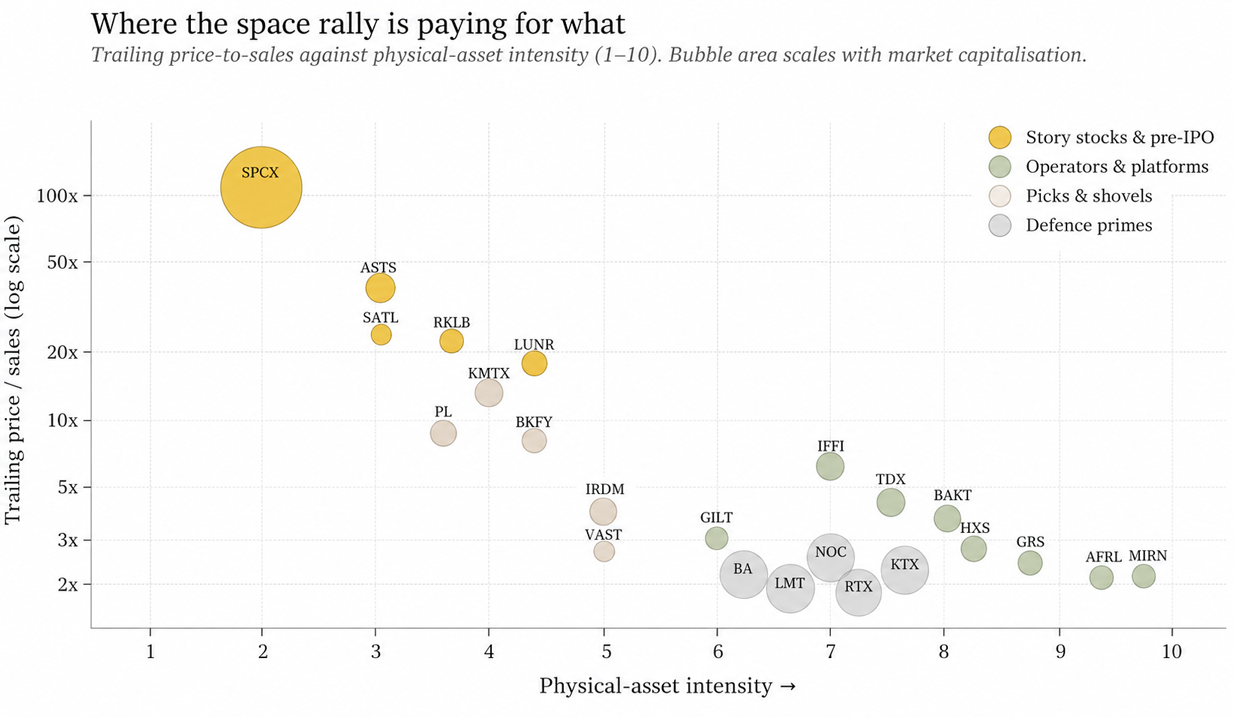
Chart 1. The space rally rerates everything, but unevenly. The market pays its richest multiple for the company with the lowest physical-asset exposure,and its thinnest multiple for the companies that produce the metal, composites and components on which the entire sector depends.
Physical-asset intensity is a Navigate‑PA qualitative score (1 = pure software / story; 10 = heavy industrial inputs). Multiples on trailing twelve-month sales; SPCX shown atmidpoint of $1.75–2.0tn IPO valuation range. Bubble area illustrative. Source: Navigate‑PA analysis; company filings; SpaceX S‑1.
The correction risks
Three are worth naming. First, concentration: roughly three-quarters of this year’s S&P gains have come from AI-adjacent names, andSPCX intensifies that concentration rather than diversifying it. Second, supply: OpenAI and Anthropic are both weighing listings of theirown, and aggregate appetite for AI-IPO exposure is finite — three offerings into one window compresses pricing on all three. Third, the bond market: 10-year yields have reached 15-month highs and 30-year yields the highest since 2007, even as growth-stock multiples sitat decade highs. The arithmetic between discount rates and growth multiples does not work indefinitely. Lockups expire at 90 to 180 days;insider selling will arrive on schedule.
Apogee
Every parabola has an apex, and the moment of weightlessness at the top is also the moment one stops ascending. The investorswho will make real money on the SpaceX
story were positioned in the network around it before the cameras arrived: the alloy mills in Pennsylvania, the composite weavers in Utah, the defence primes carrying multi-year backlogs, the small satellite firms now collecting recurring revenue from sovereigns. They are, mostly, already in the index. They are, mostly, not the things going up the most this month. The investors arriving on 12 June will, by the mechanics of mega-IPOs, fund the others’ exit; that is what mega-IPOs are for.
Gravity, in the end, has a longer track record than any of the underwriters.